Friday, July 24, 2009

And the Results...

I ran into Allen today - apparently he had accidentally deleted my name from his phone, but he figured I'd "come walking down here again." He's got a new uniform, so I almost didn't recognize him (also, I did not have my glasses) but he looks distinctly more like a police officer in long navy pants and a navy collered shirt with several badges. He hasn't stopped gambling and will not consider putting his name on any lists that would bar his access to American casinos. He's not thinking like that anymore. Instead, he has set up a bank account for his winnings and swears that the prize money is being put to good use.

When I asked about photographing the security guards, he squinted his eyes a bit and said, "Nah, you can't do any of that." Apparently it's not authorized. The Sands has barred any sort of public sight seeing and photography - this is reminding me of the Eiffel Tower at night - isn't the image of the glowing structure copy written? Allen said he'd get fired. "Somebody would see us. Somebody would rat." He remained still for most of the time, unflinching in the humidity, staring over my shoulder or down at his feet as we spoke.

"They caught some guy up on the blast furnace the other day," he started. "The cops got him as he was leaving." I inched forward and gasped a bit, although I hope not too theatrically.
"It was raining that day. He must have been trying to kill himself."

So, I have to get clearance to photograph the guards. Allen gave me the name of the chief of security but told me not to mention his name. Sure.

As always, the Sands had no idea what to do with my phone calls. The main line transferred me to security who transferred me back to the main line who transferred me to marketing where nobody picked up. I left a message.

"So many people want to photograph this place," Allen sighed. "Tourists, bikers, walkers, runners, people from the casino... and I don't blame 'em. They're just not authorized."

Thursday, July 23, 2009

Interlude Two

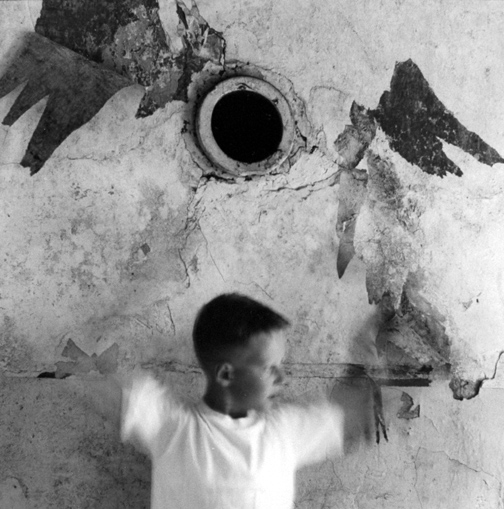
A small ounce of inspiration: my favorite of Ralph Eugene Meatyard's.
Tomorrow, I am setting out with the goal of shooting portraits. While I do love my current images, I feel like I'd do myself no favors including no human presence in this division three. I think I would like to photograph security guards. Non-literally. Non-linearly. Somehow abstractly?
This will be an experiment.

Wednesday, July 22, 2009

The Ten O'Clock Appointment

"But you put your day in. You made your eight to five, maybe you read something at night or you tried to do personal things, but it wasn’t the same as taking work home and literally sitting at a desk til the wee hours, working through things. Because what was happening from, well, the early eighties forward was the work force was being reduced. And so, as I was picking up responsibilities, under the old system as you got advanced, say to a manager, what you were doing before, somebody else would take over. And you would manage those positions. What was happening was keeping the old responsibilities and keeping the new ones. So it just got heavier and heavier. And I don’t complain about it; I enjoy it. But there is a difference ‘cuz I could remember one time particularly, going home at about seven o’clock at night, and seeing one of the people who worked in my area who went home at five o’clock, driving in the opposite direction as I was just headed home, and thinking well uh, that’s just what comes with the job. Y’know, you have a longer day than everybody else. Consequently, you do get paid more. And you should. Provided that you’re doing the job. I’ve always been a strong believer in pay for performance."

- Quoted from an interview with Stephen Donches

The One O'Clock Appointment

Tony is not available when I walk into City Hall, so I peek through the long, rectangular window into the door of his office. My first thoughts are something like, “he has been here for a long, long time.” The office is cluttered; the walls are filled with zany light up posters, hard hats, and antique looking plaques. On the far wall sits a tan slip covered sofa accented by needlepoint pillow of a loon. The windows sport long sheer curtains. When we had spoken on the phone, I imagined him as an overweight man with a bristly mustache that twitched when he said words like “business,” “investment,” or “clam chowder.” I think to myself, “I’ll know who he is before he even opens his mouth.”

A few moments later, I hear a gruff, disembodied voice. It says, “Some young lady’s here to see me. Eh? No. It doesn’t matter.” Then silence. Tony lumbers around the corner and grimaces. He is pushing an unspoken snow-white haired woman who sits demurely, hands folded in her lap. Neither look at me, seated outside Tony’s office, when he says to nobody in particular, “I’ll be right with you.” He deposits the woman in his office, moves his enormous body out the door and says something about “upstairs.” I follow his wide, circular frame down the corridor, watching his leather shoes squish and squeak with each step. Tony still has not looked me in the eye, and by this point, I am feeling terribly intrusive, a little skeptical, dismissed, but ultimately amused. I bit my tongue at the “squish, squish, squish,” of his feet.

In the elevator, Tony asks me who led me back into the office. Who instructed me to be there? Denise, his secretary, was not in. I replied, “the blonde, curly-haired woman,” and he scowled a bit. His face was very large like an overripe fruit. A second chin wobbled at his neck. Above his upper lip, his skin was wet with perspiration, and his eyebrows were like two bristly gray and black caterpillars, shriveled and drying out on the pavement of his brow.

“That’s why I’m so perturbed, I’ll have you know,” he added. “That there was nobody in the office. Of course, that’s not your fault; it’s my department.” He led me into a conference room on the second floor and gestured to one of many rolling desk chairs. “Have a seat,” he began, a hint of kindness in his voice.

I began my usual speech: I am a college student, I am writing my thesis, I am interested in the sociology of economics, but Tony cut me off. I hadn’t even had the chance to unwrap my tape recorder from the handkerchief in my purse. “I’ll tell you what annoys me with all these students and their projects about Bethlehem Steel,” began Tony. “It’s too broad. All the questions are enormous.”

I sat in my chair, knees curled up to my chest, and smiled. Tony was leaning heavily onto the table, his fat fingers restless, his pinky nail a little moldy and yellow. He wore a navy blue suit with gold buttons atop a white cotton shirt sporting an indeterminate stitched logo. I recalculated and began to throw out words such as “neoliberalism,” “occult economy,” and “service culture.” Tony smiled a frighteningly horizontal smile, very thin with the possibility of snaking around his entire grapefruit-like head. “Like an absurd South Park villain,” I thought. He talked extensively, crinkling his eyes and flashing his devilish smile throughout the duration of our forty-minute interview. I barely spoke, but Tony allowed himself to indulge the apparent pleasures he found in his own voice.

(Quotes forthcoming.)

Tuesday, July 21, 2009

More From Fowles

"There are three types of intelligent person: the first so intelligent that being called very intelligent must seem natural and obvious; the second sufficiently intelligent to see that he is being flattered, not described; the third so little intelligent that he will believe anything."

Rain, rain, rain. A surprise visit from James, all the way down from northern PA. At work with a cup of tea. A band visiting from Orlando; one is playing the piano with much hesitation. Trying not to fall asleep on the couch. Staying positive.

Monday, July 20, 2009

A Good Day

Congratulations, I have spoken with two living, breathing human beings in City Hall! My meeting with Tony Hanna, elusive king of economic and community development, is directly after my meeting with Mr. Donches. Also, as I mentioned to Maggie, "I marched myself into the mayor's office," and spoke to a secretary, who was quite kind. She took my name and number. We'll see.

Upon leaving, a toad-like man sat at a table and signed me out. He wore a nubby yellow T-shirt and took my visitor's pass. "Before you leave, I have to tell you something," he said, writing my name down. He scowled at me and scratched his head with a pen. Pursing his lips, the toad man said,

"Have a good day."

--------

Addendum:

I am at work, reading John Fowles' The Magus. Here is a rather amusing quote:

"It was unnatural, of course. But all dandyism and eccentricity is more or less unnatural in a world dominated by the desperate struggle for economic survival."

Sunday, July 19, 2009

A Letter, For Personal Use

While sitting at this table at Wired Cafe, I remind myself that I am making art in a town that has been self-obsessed with its own decay for the last two decades. This cafe is showing two bodies of work: something called "Necropolis: City of the Dead," wherein the photographer has made images of crumbling headstones and run the files through a high contrast sepia filter. The other is, from my vantage point, untitled. It documents color and texture from inside Steel.

The cafe walls augment my feeling of living within a small bubble. So many artists who have walked the south side have photographed Steel, and the businesses seem to relish the imagery on their walls as if to say, "see, we have culture and history too!"

Creating images of Steel, I must remind myself that what I am doing is genuine and establishes different motives. Call it survival theory. These walls here memorialize. They authenticate the past. They subscribe to a linear narrative of birth, life, death. Then consumption. While romantic, these images seem quite literal. In sequence, I see repetition. In my images, the only way to communicate is through careful pairing of image by image or precise selection of a photograph to command on its own. My representation of the machine shop could look quite similar to "Artist X's" because how far can one push the aesthetic of a singular, stagnant object?

Photography is like poetry - one builds meaning and emotion through pauses, breaks, structure and chaos. Through stanza and through play. I remind myself that I am breaking in, and that these images will not strictly be shown as a cultural memorial on the side of town where the executives ordered their mansions built. I cannot risk becoming too untrustworthy of myself while living Bethlehem, a city which often tokenizes and cheapens its history. The commodification of the past could fall in line with romanticizing. It is done, in part, to normalize experience and thus make experience recognizable and useful in the present. In Bethlehem's case, I am speaking of the polarized service community.

I must also remind myself that ultimately, I am doing work. We are in the height of summer. I am living, I am thinking, I am acting (therefore I am?) Therefore, this project is evolving. I think I'm doing better than I had imagined, especially concerning solitude. Quite frankly, sometimes to be alone in Bethlehem manifests itself so intensely that the feeling becomes physical. But I can still walk down the street and do something like this: sit at a tall table and be in the company of strangers.

Here's to feeling less sick with loneliness, iced lattes, and yes, I'll say it: bad art.

The Height of Summer

Vinny came around back and squeezed through the doorframe. He chewed on a piece of white bread, saliva collecting at the corner of his mouth. The whole shack swelled to contain Vinny and Sawyer and the little deck chair and the spirals.
“What a fat fuck,” thought Sawyer, and he dropped his pen. “Yeah, sure, I’ll check it out in a sec, okay?”
He paused. “Whaddya have there?”
“White bread.”
“Nothin’ on it?”
“Nah man. Nothin’ on it.”
Vinny smiled, bearing a set of five teeth caked with wet, starchy particles. His mouth looked like a culture, a Petri dish, something that moved and multiplied at an infinitesimally viscous rate.
Sawyer felt pretty bad for Vinny, but not bad enough to warrant any tangible sympathy. A smile and nod would do, but he wouldn’t go near a pat on the back. The thought made him anxious. Imagining slow things crawling up through Vinny’s work shirt, viral things that made him sweaty and dirty or maybe just dumb, Sawyer shook his head a bit and said he’d be up at the shop in a jiff. Vinny could sit here and watch the trucks.

------

I'm back in Bethlehem; the temperature is 79 degrees. I have a handful of new contacts that I plan to find in this town. While looking over negatives, Jack gave me the name of the guy who "knows where all the bodies are buried," and his name is Dr. Ralph Schwarz, a Moravian historian and archivist. Also, there's the Morning Call's economist, a one Mr. Afshar, and then a handful of people Barbara has mentioned.

I think I am going to wake up early tomorrow and saunter down to City Hall. I'm becoming increasingly frustrated with Bethlehem politicians and their apparently lack of accountability. It's harder to ignore a human being in the flesh. As to what I'm actually going to say or try to accomplish when I get there... I suppose I'll figure that out on the walk down New Street.

Tuesday, July 14, 2009

Finally

I think that by now, Jerry Green's entire office must be laughing at me. I can't begin to calculate how many times I've phoned over to the local union to be met with the same, "Jerry's not in the office," line. I saw a YouTube video of him, so perhaps there's now proof that he really exists. Or maybe he has a doppelganger. Or several. We'll see.

On a good note, I scored an interview with one of the heads of the National Museum of Industrial History, Stephen Donches. (Somebody actually picked up a telephone!) When I originally asked about permission to photograph inside Steel, a secretary handed me the number of the Sands (484 777-7777)... lucky number 7, anyone? When I phoned over and asked the secretary who I could talk to, she paused for just a bit too long for comfort and then said something to the extent of, "uhhh most of our pictures go to advertising. I can transfer you there." Nobody in advertising picked up. I think this is a good thing.

Tomorrow, I'm meeting Barbara Flanagan, a woman who I found tending her garden on Wall Street as I biked by with my camera. I slowed to admire the garden (herbs popping up through the old brick walkway, lilies, lilacs, the whole nine yards), and we began talking. Barbara is an architectural writer and critic, also an artist, ex-council member, Jewish convert and mother. Also she's exceptionally kindhearted, and when I thanked her for a really inspiring conversation about art, politics, and life in general, I told her that the chat had been the best thing to happen all day. Her response? "Well then you must be living a boring life!" In any event, one of her interns who works Wednesdays actually graduated from Hillsborough (ancient history!) and she thinks we should meet. So we will. Hopefully Isaac will be here by then. I'll have already made red velvet cupcakes with Dani, and then it's poker night. Then we're off to New Jersey for a few days to take a bit of a break, sleep in a real bed (read, not on the floor), and cook several delicious lunches and dinners. I just have to, somehow, get through today.

"oh hai"

Monday, July 13, 2009

Snippet

Today was Thursday. The day when the girls came in at five and left past two, removing thick dollar bills from their bosoms, and Sawyer wondered about the room in there, between sticky skin and gold sequined minis. He only got the girls on the early morning shift: the fat one with caked red lipstick who brought him Coca Colas or the sleepy eyed blonde who Sawyer imagined unfurled in routine with the sun. He tipped them with parts of his winnings and chips, thinking about dawn that he could not watch rise from the floor.

Sawyer was in love with the sleepy eyed blonde, whose name was Serafima Ivanov. Serafima Ivanov’s favorite sweets were licorice vines spun into wheels; she fancied Shostakovitch and Woody Allen. Her candied black discs sat on a small shelf between the martini glasses and toothpicks. During the slow shifts when Sawyer dragged at his Coca Cola and cranked at the machines with calculated indifference, Serafima placed a wheel between her lips and sucked. From behind the blinking crests of the slots, Sawyer followed the movements of the little pink tongue inside Serafima’s mouth.

++++

(From a short story, inspiration is obvious. I think this div three is turning into a collection of oddities... words, images, fiction, non fiction... I am content with this.)

Saturday, July 11, 2009

Briefly

I have counted a disconcertingly disproportionate number of funeral homes in downtown Bethlehem. I run into one at what seems to be every corner.

Also, my job rules. I am reading apartment therapy, talking to Maggie, drinking coffee, and listing to (questionable) live music. Ce'st la vie.

Thursday, July 9, 2009

Notes 4

  1. Jerry Green, the president of United Steelworkers of America Local 2599, has been, as far as I am concerned, MIA from his office for the last month.  
  2. Most organizations, businesses, and historical societies do not pick up their phones.  In fact, I am questioning if these places even have phones.  Perhaps the directories are filled with road to nowhere telephone numbers that lead to automated answering machines which supply you with the number you have just dialed and the vague explanation, "this particular number is unavailable."
  3. Messages on these machines repeatedly go unanswered.
  4. I photographed at sunset last night, catching the orange glow of the stacks.  Ontop of the catwalks, my heart was jumping out of my throat.
  5. I've started to write a short story, which I hope to try to loosely categorize as "something akin to magical realism," but it probably won't get that far.  We'll see how long it takes for me to sack it.
  6. I have discovered a small organic bakery on a side street running parallel to Broad.  It is only open on Thursdays and Fridays, and the baker seemed kind.  Walking down Milton Street to Main this afternoon, the quiet seemed oppressive... everything was still, and the things that should have made sounds did not.  The street is barely wide enough for one car or three people, but its charm appears in the seemingly haphazard array of antique cornices and parapets, and I think I'd like to start photographing in town.  Also, I think I'd like to make portraits of the security guards around Steel, Sands, and the Industrial Park.  I had an amusing and somewhat quintessential run-in with a sleeping security guard a few nights ago.  His name was Alexander, and when I apologetically crept up to his post and said, "I'm sorry to bother you, but..." he jerked upright and jumped out of his desk chair.  Very flustered.  He told me about the lines that used to run from "here" (right above his shack) to some posts over the mountain in Hellertown, back when Steel was in its heyday.  Most of the guards I've met have been relatively adorable old men who at one time were employed by Steel and "do the guard thing" as a second job or because they are retired.  I think my photographs would benefit from their faces and stories.
  7. To pass the time, I have taken up needlepoint and cross stitching.  Currently reading Graham Greene, Amy Hempel, and Haruki Muramaki.  Missing western Mass, New York, Providence, and, of course, New Jersey.

Tuesday, July 7, 2009

The Railroad and the Girl


walker evans, bethlehem, 1935